- Dec 9, 2025
Why I Still Work on My Relationship Anxiety When Married
There's something quite vulnerable about admitting this: I'm a self-love coach who specialises in healing anxious attachment, yet I still work on my relationship anxiety when married. Every single day, I show up for my own healing journey. And here's the truth I want you to understand—I'm here doing this work for a reason. Relationship anxiety didn't just visit my life; it ruled it for years, and so there's not always just a magic switch you can flick. Here, allow me to explain... (Because the good news is, it's also not as bad as it sounds!)
How Relationship Anxiety Ruled My Life
So I guess the best place to start would be from the top.
See, my story isn't unique, but it is mine. Teenage trauma left invisible scars that I didn't understand for years. Those scars became the lens through which I viewed every romantic relationship that followed.
What came next was a string of toxic relationships—each one reinforcing the belief that I wasn't enough, that love was conditional, that abandonment was inevitable.
I became hypervigilant to signs of abandonment. A delayed text message felt like a catastrophe. A change in behavior meant the relationship was ending. I was exhausting myself trying to control the uncontrollable, seeking reassurance that never quite satisfied the ache inside.
Dating anxiety when I was single was relentless, relationship anxiety - once I got into a relationship was excruciating, and it was destroying my capacity for genuine connection.
This is why I do what I do. Because I've lived it. Because I know what it feels like to be trapped in that cycle, and I know—deeply—that healing is possible, even if it doesn't always look exactly how you may think or expect.
The Uncomfortable Truth About Marriage and Anxiety
Because hey, here's what surprised me most after getting married: relationship anxiety didn't magically disappear when I said "I do." The wedding ring, the commitment, the vows—none of these things automatically rewired my nervous system.
And that's why I want you to know: if you're experiencing anxiety in your marriage despite your commitment, you're not broken, and your marriage isn't doomed.
Relationship anxiety will still show up in marriage if the underlying attachment wounds haven't been properly addressed. But here's what's even more important to understand: even when you've done the work, even when you've healed those wounds and moved from anxious to secure attachment—anxiety can still make guest appearances. This isn't failure. This is being human.
After all, marriage doesn't erase our history. It doesn't delete the neural pathways that were carved during times of trauma or instability. What marriage does offer is a consistent, safe container within which we can continue healing. But that healing? It's ongoing work, not a destination.

The Neuroscience Behind Why Relationship Anxiety Persists
There are many different causes of relationship anxiety (far more than you might think or expect, actually), but regardless of the root cause, understanding the science helps us extend compassion to ourselves.
When anxiety shows up, it's not because you're doing something wrong.
It's because your nervous system is doing what it was trained to do: protect you from perceived danger. The work is teaching it that safety exists here, now, in this relationship.
Here's how it tends to unfold:
Neural Pathways: Our brains form neural pathways through repetition. Years of anxious attachment create well-worn pathways that don't disappear overnight. These pathways can be reactivated under stress, even after healing.
Threat Detection Triggers an Amygdala Response: The amygdala, our brain's threat-detection centre, becomes hypersensitive in those with anxious attachment. It can still fire alarm signals in response to perceived relationship threats, even in secure relationships.
Anxiety is Triggered: Traumatic relationship experiences are stored as implicit memories—felt experiences without conscious narrative. These can be triggered without warning, causing anxiety that feels disproportionate to current circumstances.
Why Anxiety Returns Even in Secure Attachment
Now I also want to mention, that there's a common misconception that becoming securely attached means never feeling anxious again. This simply isn't true. Secure attachment doesn't mean the absence of anxiety; it means having the tools and awareness to move through anxiety without it consuming you.
Research shows that even securely attached individuals experience moments of relationship anxiety, particularly during times of high stress, major life transitions, or when old wounds are inadvertently triggered. The difference is in the recovery time and the ability to self-soothe.
Important distinction: Secure attachment means you can recognise anxiety as a temporary visitor, not a permanent resident. You don't identify with the anxiety; you observe it, understand it, and let it pass. In contrast, anxious attachment often leads one to perceive anxiety as an inherent part of their identity, allowing it to become consuming. But ultimately - both can experience relationship anxiety, of course.
The Stress-Vulnerability Model
Psychologists refer to the stress-vulnerability model when explaining why certain patterns re-emerge under pressure.
Think of it this way: we all have vulnerabilities—areas where we're more susceptible to old patterns resurfacing. For those of us with a history of struggling with relationship anxiety, relationship anxiety is one of those vulnerabilities.
When we're well-rested, emotionally regulated, and our needs are being met, we can maintain secure functioning relatively easily. But introduce significant stressors—illness, work pressure, family conflict, financial worry, triggering situations, sleep deprivation—and suddenly those old anxious patterns can creep back in.
This doesn't mean you've "lost" your progress. It means you're experiencing a normal human response to stress. The key is recognising this pattern.
When I notice my relationship anxiety increasing, my first question isn't "What's wrong with my marriage?" It's "What's happening in my life right now that's taxing my nervous system?" Often, the anxiety is a signal that I need to tend to my own wellbeing, not evidence that my relationship is in danger.
Why It's Natural to Still Experience Relationship Anxiety When Married
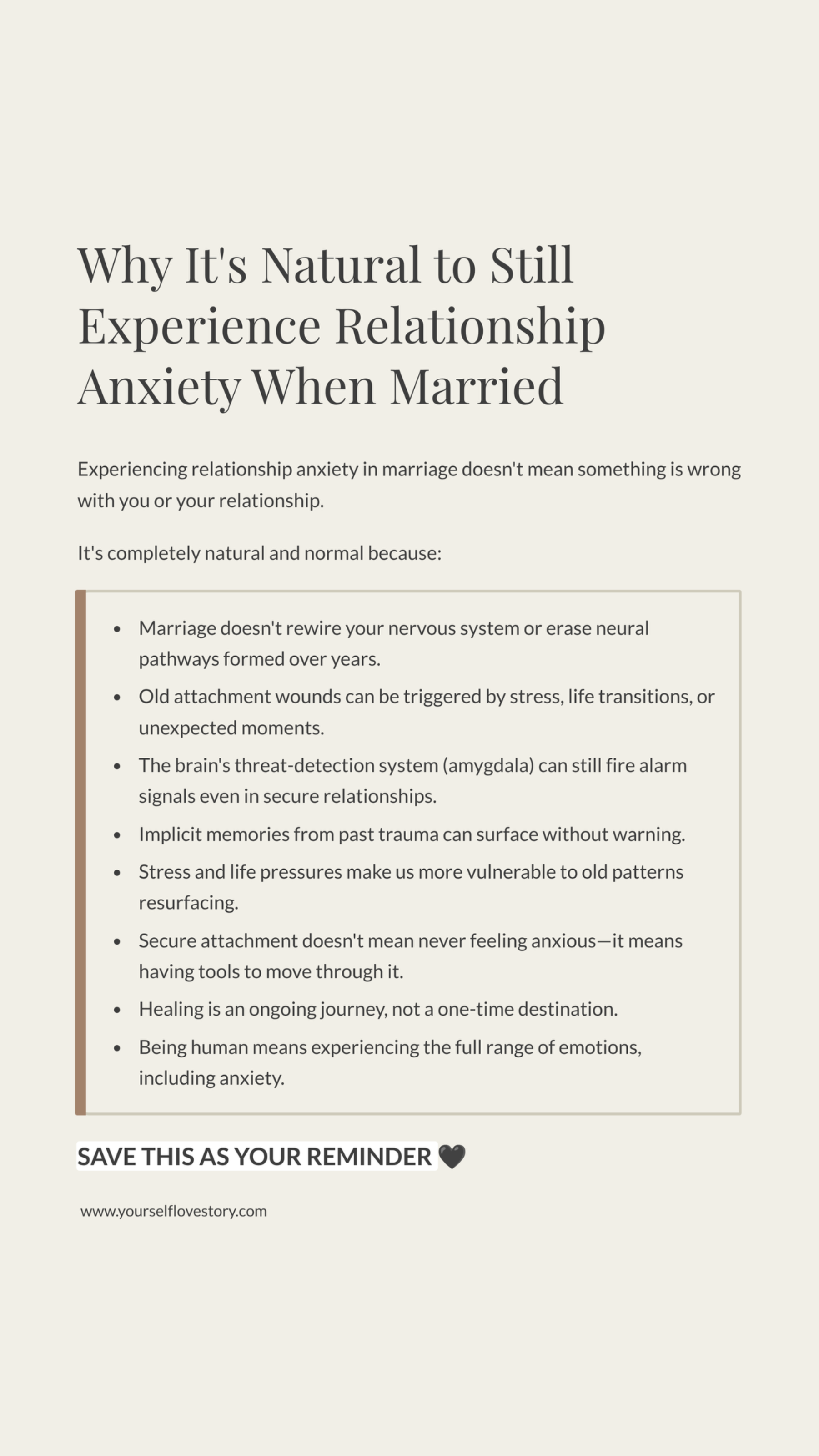
So in a nutshell: experiencing relationship anxiety in marriage doesn't mean something is wrong with you or your relationship. It's completely natural and normal because:
Marriage doesn't rewire your nervous system or erase neural pathways formed over years.
Old attachment wounds can be triggered by stress, life transitions, or unexpected moments.
The brain's threat-detection system (amygdala) can still fire alarm signals even in secure relationships.
Implicit memories from past trauma can surface without warning.
Stress and life pressures make us more vulnerable to old patterns resurfacing.
Secure attachment doesn't mean never feeling anxious—it means having tools to move through it.
Healing is an ongoing journey, not a one-time destination.
Being human means experiencing the full range of emotions, including anxiety.
But that's why I continue to work on my relationship anxiety when married, and I recommend that you do the same thing too.
10 Things I Do To Keep Anxiety At Bay
To offer a few insights / pointers on what I personally do to help keep my relationship anxiety at bay, even now I'm married, I focus on:
Daily Nervous System Regulation: Morning meditation, breathwork, or gentle yoga to start my day from a grounded place.
Consistent Communication: Regular (but not incessant) check-ins with my partner about feelings, needs, and connection—not waiting for problems.
Maintain Independence: Nurturing my own friendships, hobbies, passions and sustain my identity outside the relationship.
Constructive Engagement: Focusing on meaningful tasks to redirect anxious energy during triggering events and prepare for them - have a plan already in place before they come up.
Consistent Negative Thought Challenging: Regularly questioning and reframing anxious thoughts to prevent them from spiraling into pervasive worry. This means also being very aware of my thoughts, again, especially when potentially-triggering situations are coming up.
Physical Movement: It sounds simple, but it's one of the self love lifestyle choices for a reason! Regular exercise to metabolise stress hormones and release endorphins.
Sleep Hygiene: Prioritising 7-9 hours of quality sleep—anxiety thrives on exhaustion
Boundary Setting: Saying no to obligations that deplete me and yes to what nourishes. Also maintaining healthy boundaries in my relationship.
Gratitude Practice: Actively noticing and appreciating what's working in my relationship, and counting my blessings every single day.
Continuous Learning: Staying educated about attachment and relationship psychology. I also re-do my 30 Day Relationship Anxiety Challenge at least twice a year, as I find I take new things away from it every time and it sustains the essential habits I need, with ease, from there too.
When Anxiety Flares: The Strategic Intervention Approach
Despite all the preventative work, anxiety will occasionally flare up. And so, when it does, I turn to a structured approach to rapidly shift my state.
These aren't theoretical techniques—they're what actually works when my heart is racing and my mind is spinning catastrophic scenarios.
The Strategic Intervention Process I Use:
Pattern Interrupt: Immediately break the physiological and psychological cycle of anxiety. This can be anything from a loud clap, a sudden change of location, or a dramatic shift of movement.
Change Physiology: I then use movement, adjusting my posture to feel more powerful and confident. And I do deep diaphragmatic breathing, whilst pulling my shoulders back and making my expression feel more positive. Energy flows where focus goes, and changing your physical state changes your mental state. (If you don't believe me, try it!)
Ask Empowering Questions: Instead of allowing my thoughts to escalate to the "what if's" that lead from my anxiety, I pause, take a moment, acknowledge the anxiety that is there, then ask more helpful, empowering questions like, "What can I learn from this?" or "What's something positive about this problem?" Shifting your questions shifts your focus and meaning.
Reframe the Meaning: And last but not least, I challenge the interpretation of the anxious event. What if this isn't a threat after all? What if this feeling is energy that can be redirected? Changing the meaning changes the emotion associated with it.
This process helps to regain control and move from a disempowering state to an empowering one, even in the midst of anxiety. It's my go-to reset.
Other Calming Strategies That Work
There's endless tools and approaches. It's all about finding the ones that work best for you. But if you're still wondering what to do if you're struggling with relationship anxiety when married, right there, in that moment, start by trying to:
Name the Feeling: Say out loud: "I'm noticing anxiety." This simple act of labelling emotions reduces their intensity. It creates space between you and the feeling—you're observing anxiety, not drowning in it. And can start to think more rationally and logically from there.
Reality Check Questions: Ask yourself: "What evidence do I have?" "Am I responding to what's actually happening or what I fear might happen?" This engages the rational prefrontal cortex, calming the emotional amygdala.
Physiological Sigh: Take two quick inhales through your nose, followed by a long exhale through your mouth. This breathing pattern rapidly reduces anxiety by engaging the parasympathetic nervous system. Repeat 2-3 times.
Physical Release: Shake your body, do jumping jacks, or dance. Anxiety is energy trapped in the body. Physical movement helps metabolise stress hormones and discharge that energy. (This is similar to what I do with my strategic intervention technique.)
5-4-3-2-1 Grounding Method: Name 5 things you can see, 4 things you can touch, 3 things you can hear, 2 things you can smell, 1 thing you can taste. This sensory exercise brings you back to the present moment, interrupting the anxiety spiral.
Sometimes, the most powerful thing you can do is simply tell your husband or wife what's happening. "I'm feeling anxious right now, and I know it's not about you. I just need you to know." This vulnerability, this honesty—it's what transforms anxiety from something that threatens connection into something that deepens it.
✨ Quick Exercise: What's one thing you'll try next time you feel anxious in your marriage? Decide right now, write it down and commit to it.

The Ongoing Journey of Secure Love
Marriage didn't immediately cure my relationship anxiety, and honestly, I've made peace with that. What marriage has given me is a safe relationship within which to continue healing. It's given me a partner who understands that my anxiety isn't about him—it's about old wounds that occasionally ache.
If you're doing this work too—whether you're married, in a relationship, or preparing for future love—please hear this: your ongoing healing isn't evidence of failure. It's evidence of commitment to yourself and to love.
Every time you choose awareness over reactivity, every time you soothe your own nervous system instead of demanding your partner fix your anxiety, every time you show up for this work—you're breaking generational patterns. You're rewriting your story.
Relationship anxiety may visit from time to time, but it no longer runs my life. It no longer determines how I show up in my marriage. And the same can be true for you.
This work—this beautiful, challenging, deeply worthwhile work—is how we transform our capacity for love. Not by becoming perfect, but by becoming aware. Not by never feeling anxious, but by knowing we have the tools to move through it.
Keep going. Keep healing. Keep loving yourself through every wave of anxiety that comes. You're exactly where you need to be.
Your Next Step: Let's Do This Together
So hey, if you've read this far, it's clear this isn't just idle curiosity anymore. You've been grappling with relationship anxiety, and you're tired of it calling the shots. You're ready to actually do something. Ready to rewrite your story, ready to build a love that feels genuinely secure.
This isn't about distant hope or theory; it's about practical, lasting transformation, right here, right now. I don't want this to be just another article that you read, which led to 0 change. So here's what I suggest...
If You're Just Starting
If you found this blog post valuable, and you're just beginning your exploration, your first step is simple: download our free comprehensive Relationship Anxiety Ebook. It's packed with foundational wisdom and practical exercises to gently guide you through the initial stages of understanding and managing your anxiety. Click Here To Download Your Free Ebook Now
Ready for the Next Step?
For those who have already absorbed the ebook's wisdom and are yearning for sustained, active transformation, it's time for a brave next step.
Join our 30-day Relationship Anxiety Challenge. This isn't just another program; it's a deeply supportive journey where we work through this together, day by day, for 30 impactful days. We'll make those coping strategies natural and automatic, not forced, with practical guidance and unwavering support.
And because we believe in this work and in you, it comes with a complete money-back guarantee—it's completely risk-free. There's no better moment than this.
This challenge comes from a place of deep care and understanding. I'm reaching out my hand to help you truly transform your relationship with anxiety and embrace secure love.
That's All For This One
So what do you say? What's one small thing you're going to take away from this and try out if - like me - you're still living with - to whatever degree - relationship anxiety when married?
What's the next step you're going to take - will you join me over on the 30 Day Challenge, or start with the Free Ebook?
There's no right or wrong. Your Self Love Story will still be here waiting whenever you need. But I truly believe now is your time... And I think you know that too. 🖤
So let's have a go at writing the next, healing chapter in #yourselflovestory, tackling this relationship anxiety, once and for all, shall we? So that it's no longer something to dread or fear.
You've got this, and I've got you every step of the way too. You are not alone.
Sending all my love & encouragement,
Ell, The Founder of Your Self Love Story